27.08.2026
High End Technology
We develop extraordinary camera systems for highly demanding defence, police and security, industrial and medical customers that require a solution.
Understanding Night Vision
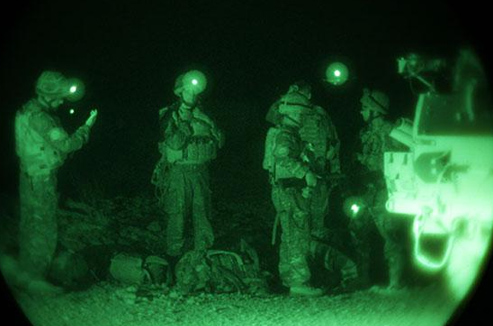
True night-vision is only achieved with an image intensifier tube. These devices catch photons in a photo-sensitive layer and convert those into a very small electron current. These electrons are then amplified in an element called Micro-Channel-Plate (MCP) and then displayed on a small greenish phosphor screen.
ITS used to offer an intensified camera in the product called “Pulsatrix”. Because of cumbersome supply and high cost, the product was discontinued some time ago. The camera offered true star-light performance and featured shot-noise level imaging. Upcoming sensitive CMOS sensor rendered the Pulsatrix obsolete. Not on performance but the economics just does not work.
Although the photocathode is sensitive to light in the color spectrum, most photons are caught at night in the NIR region. These photons invisible to the human eye are converted to visible light by the I2 tube. This device is really very good at displaying an image even when the sky is clouded and starlight is almost completely blocked. Amplification is > 10.000 and this is by far the best way of imaging at night. The image is very natural to the user and faces and objects can be easily recognized. Color representation is impossible but not required for night operation.