27.08.2026
High End Technology
We develop extraordinary camera systems for highly demanding defence, police and security, industrial and medical customers that require a solution.
Understanding LWIR sensor
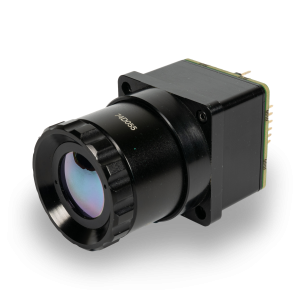
This detector is also a focal-plane-array or FPA. In this case the FPA does not work with photons as these are too low in energy to pick up. Instead, the FPA is made up of small “islands” sensitive to heat. Such a sensor is referred to as a microbolometer. Each pixel is attached to long “arms” to minimize heat transfer from the pixel to the array, as shown below. Our products that meet these requirements are the Vipera Thermal Cameras.
In this picture, the pixel size is 25µm. Those are hardly ever used anymore. Most of the sensors now have a 17um or 12um pixel pitch.
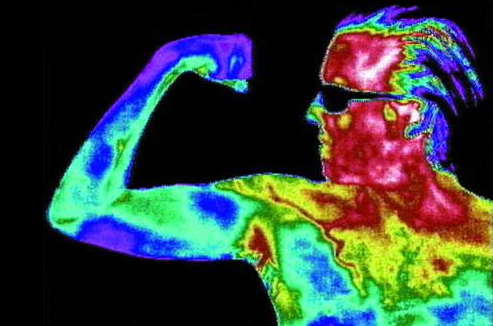
Such a heat sensitive sensor is not sensitive to light. So day and night scenes all look alike, apart from the fact that the sun may heat up a scene causing some sensation of shade. But absence of light does not generate noise, it just picks up temperature variations within a scene. That makes the detector perfect for navigating and observing all kinds of ranges, as you can see from the very first image in this document. A drawback of such a micro-bolometer is that all pixels introduce errors. They all have a slightly different response to heat radiation and the raw image from the detector is difficult to interpret as such. A non-uniformity correction (NUC) is required. This NUC can be achieved in any of three ways:
Shutter
A small mechanical element blocks the optical pathway momentarily. The camera then takes a snapshot of the sensor noise and subtracts it from the incoming signal (open shutter). The remaining image is then that of the scene. The main disadvantage is that the shutter blocks the scene quite frequently and in a combat situation this is often undesirable. When the surrounding temperature changes (from indoors to outdoors for example) the shutter operations can be as frequent as once every few seconds.
NUC calibration
When assembly of the camera and lens is completed, ITS calibrates the non-uniformity over a wide temperature range. The camera will sense the temperature of the detector and retrieve the proper calibration.
Scene based NUC
The idea behind this is that when a user travels with a camera, either on a helmet, hand-carried or on a vehicle, the image moves while the non-uniformity is static. ITS has an algorithm that can distinguish between scene and noise and calculates the best possible correction for the scene, and this results in a very clear image. The algorithm requires some computational power and is not implemented at this time in our Vipera cameras.