27.08.2026
High End Technology
We develop extraordinary camera systems for highly demanding defence, police and security, industrial and medical customers that require a solution.
Understanding SWIR Detector
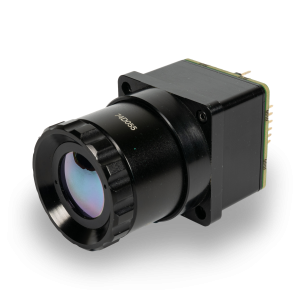
The next region in the spectrum is SWIR, or short-wave-infra-red. It is adjacent to the NIR region in terms of wavelength. The energy of the photons is lower than in the color or NIR region. This is why they are not detected by standard silicon sensors, like CMOS imagers, and not by the photocathode of an I2 tube. Our product with a SWIR detector is called Ruby 6-15 SWIR.
For this wavelength, you need a different material than silicon. A material that performs very well in this range is a doped version of a so-called III/V-material: InGaAs or Indium-Gallium-Arsenide. The pixelized surface made of InGaAs is called a Focal-Plane-Array (FPA). Each pixel works as a CMOS pixel; it catches a photon and transfers this to electrons. The material of the FPA, however, is not suitable to carry the signals to an output. This is why a FPA is always connected to a readout structure that sits under the FPA. Each pixel has its own connection to the readout fabric. This readout structure for the FPA is often referred to as a ROIC (read-out-integrated-circuit). This looks a bit like this.
The bump-bonds are the connection from the SWIR sensitive pixels to the readout fabric. This is relevant to understand why the resolution of any FPA is often much lower than the megapixels found in a CMOS. The size of the bumps is limited and determines the pixel size for a large part.
Sony recently came up with a way of converting SWIR photons inside a special Quantum dot layer to visible photons that can be picked up by a regular CMOS. Their resolution is much higher than with the current FPA sensors like the Snake from Lynred or Cardinal from SCD. But the Sony detectors are not released for the defense industry yet and are not an option for us to integrate.
The main advantage of SWIR is that there are quite a lot of SWIR-photons available at night. During daytime, the sun illuminates and charges certain layers in the stratosphere. This charge is released during the night, thus providing the nightglow. This makes the sensor very useful at night, but it should be noted that night-glow is not stable throughout the night.
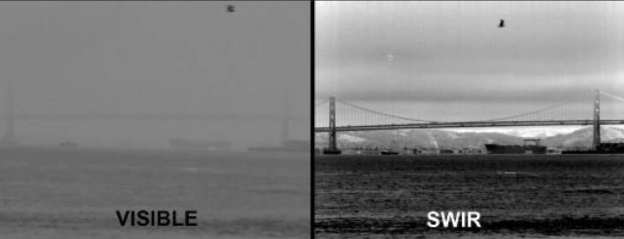
Another advantage of the SWIR imaging band is that the SWIR photons travel through the atmosphere uninhibited by moisture in the air. Even imaging through fog over long distances over sea are possible.
In the SWIR region it is still possible to identify people, but it is a bit trickier because for example hair shows up differently. Also, vegetation comes up very bright because of the reflectiveness of SWIR photons by chlorophyll in the leaves. Below is an example of how a person looks differently in SWIR compared to visible.